
No products in the cart.
Keysight EXR208A: Choosing an 8-Channel, 2 GHz Oscilloscope for Debugging
Tech Highlights5 min read
OSCILLOSCOPE SELECTION GUIDE
When eight channels make debugging easier
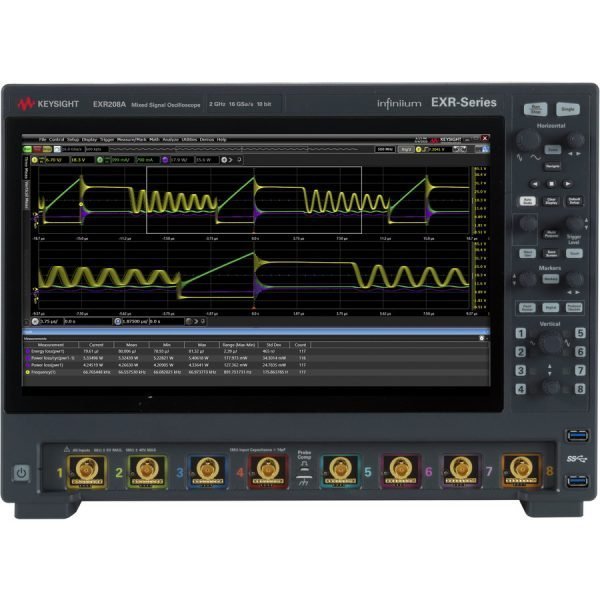
A fast fault rarely appears on one signal alone. The Keysight EXR208A pairs eight analog channels with 2 GHz bandwidth so engineers can compare clocks, resets, buses, supply rails, and control signals in one time-aligned capture. This guide explains how to judge the specifications against your actual debug task.
At a glance
For multi-channel bench debugging, the EXR208A configuration listed by Asiamultimeter combines 8 analog channels, 2 GHz bandwidth, 16 GSa/s maximum sample rate, 100 Mpts of standard memory per channel, and a 10-bit ADC. Higher memory and digital logic channels depend on the chosen options.
- 8 analog channels and 2 GHz bandwidth for this model
- 16 GSa/s sample rate on each channel simultaneously
- 100 Mpts standard memory per channel; upgrade paths are available
- 10-bit ADC, with high-resolution mode up to 16 bits
- 16 digital channels require the EXR2MSO option
Use the channel-planning guide, bandwidth check, and buying checklist below to decide whether the configuration fits your signals.
Start with the signals you need to see together
The first question is not “How many channels does the scope have?” It is “Which signals must be compared in the same acquisition?” A board-level investigation might need a clock, reset, serial data, enable, two supply rails, a current-monitor output, and a trigger signal. Eight analog inputs can keep that set together while you inspect timing relationships.
Write down the signals and probe types before comparing models. A current probe, differential probe, and passive probe have different bandwidth, loading, voltage, and safety limits. A suitable scope cannot compensate for an unsuitable probe or connection.
Match bandwidth to the edge you need to inspect
Bandwidth describes the range of signal frequencies the oscilloscope measures within its specified response. Clock frequency alone is not enough to determine the bandwidth you need: fast rise and fall times contain higher-frequency components that shape the edge. If the scope or probe bandwidth is too low, transitions can look slower or smoother than they are.
Start with the fastest transition and highest-frequency detail that matter to the debug question. Include ringing, overshoot, switching transients, and serial edges when relevant. The EXR208A is the 2 GHz, eight-channel model; confirm the complete probe-to-scope path and the required measurement uncertainty before selecting it.
Read sample rate and memory as a pair
Sample rate is how often the input is digitized. Memory depth is how many samples can be retained. A fast sample rate helps preserve detail around a quick event, while deeper memory can keep a longer sequence in view. Longer time spans and multichannel operation can change the acquisition conditions, so check the exact mode instead of assuming every maximum is available at once.
The EXR-Series datasheet lists 16 GSa/s on every channel simultaneously and 100 Mpts of standard memory per channel, upgradeable to 400 Mpts or 1.6 Gpts flexible memory. The Asiamultimeter EXR208A listing identifies its configuration with 100 Mpts. Confirm the memory option on the quotation if a long capture is important.
Understand vertical resolution without overstating accuracy
The 10-bit ADC converts the input voltage to digital codes. More nominal quantization levels can help show small changes over a selected range, but ADC bits do not equal measurement accuracy. Noise, linearity, front-end range, probe attenuation, and setup all influence what the trace can show.
Keysight lists high-resolution mode up to 16 bits for the EXR-Series. Treat this as a mode capability, not a promise that every signal will resolve to 16-bit accuracy. Check the model datasheet for the operating conditions and use the right vertical range and probe.
A practical eight-signal debug plan
For a converter or embedded board, arrange the capture around one question, such as whether a reset occurs when a rail dips or a control edge changes near a switching event. A useful channel plan could include:
- Clock and reset to compare timing at the system boundary
- Serial clock and data to correlate a transaction with the fault
- Enable or trigger output to mark the operating state
- Input and output rails to observe supply behavior
- A current-monitor waveform when it is needed to understand load response
This is a planning example, not a measured EXR208A capture. Choose probes for the expected voltage, common-mode range, current, bandwidth, and transient environment. Follow the probe and instrument manuals and your organization’s electrical-safety procedures. Never connect a grounded probe in a way that could short a live node to earth.
Oscilloscope selection checklist
- Channels: How many independent signals must be captured at once?
- Bandwidth: What is the fastest edge or frequency detail that matters?
- Sample rate: Does the acquisition mode preserve enough time detail?
- Memory: How long must the event history be, and which memory option is included?
- Vertical performance: Are the ADC, noise, range, and probe combination suitable?
- Options: Are logic channels, decoding, or analysis packages included in the quote?
- Workflow: Can engineers save, label, compare, and reproduce the capture?
Where the Keysight EXR208A fits
The EXR208A is worth evaluating when a bench workflow benefits from eight analog channels and 2 GHz bandwidth in one instrument. Its 16 GSa/s sample rate and 100 Mpts per-channel standard memory provide useful starting points for fast, correlated captures. If you need 16 digital logic channels, the EXR2MSO option is required; do not assume it is part of the listed configuration.
Compare it with other digital oscilloscopes if your channel count or bandwidth requirement is lower. For measurements where portability matters more than eight-channel synchronization, consider a Fluke 190-102-III-S handheld oscilloscope.
The current seller configuration and price are shown on the Asiamultimeter Keysight EXR208A product page. Confirm model options, probes, software, calibration documents, availability, and quote details before ordering.
Frequently asked questions
Is 2 GHz enough for every high-speed design?
No. Required bandwidth depends on edge speed, signal content, probe performance, and the measurement objective. Compare the full signal path with the fastest event you need to resolve.
Does the EXR208A include 16 digital channels?
The 16 digital logic channels require the EXR2MSO option. Confirm option inclusion in the quotation.
Does 10-bit resolution mean ten-bit accuracy?
No. ADC resolution is only one factor. Noise, linearity, voltage range, probe performance, and setup also affect accuracy and the ability to distinguish small changes.
How much memory is standard?
The EXR-Series datasheet lists 100 Mpts per channel as standard memory, with upgrades to 400 Mpts or 1.6 Gpts flexible memory. Verify the exact option for the EXR208A configuration being quoted.
Specifications and product references
Model and configuration details were checked against the official Keysight EXR208A page and the Keysight Infiniium EXR-Series datasheet. See the Asiamultimeter product listing for current seller configuration and pricing.
Leave a comment